
Calm Is Not a Personality Trait
We often look at certain leaders and think, “She’s just naturally calm.”
As if calm were eye colour. Or height. Or something you’re simply born with.
We tell ourselves that some people are wired that way — steady, unshakeable, composed under pressure.
And the rest of us?
Too emotional. Too reactive. Too intense.
But here’s the truth.
Calm is not a personality trait.
It is a practice.
It is a discipline.
It is a courageous choice.
Calm is something we build.
The Myth of the “Naturally Calm” Leader
In leadership, calm is often mistaken for temperament.
We assume it belongs to the quiet introvert. The logical thinker. The person who doesn’t seem easily rattled.
But what you’re often witnessing is not personality — it’s capacity.
Capacity built over time.
Moments where they wanted to snap… and didn’t.
Times when their nervous system was screaming… and they chose to steady it.
Situations where fear rose up… and they learned how to sit with it instead of letting it steer.
Calm is earned.
It’s forged in the heat of challenge, when your heart is racing and your mind is spinning like twenty browser tabs open at once.
Especially in stressful moments.
Especially when the stakes feel high.
Especially in personal life’s losses, where we question our own direction whilst trying to lead.
Calm Is a Choice You Step Into
There are moments in leadership where it feels like running on a treadmill that’s going too fast. Pressure in your chest. Noise in your head. Everyone waiting for you to respond.
And in that moment, you have a choice.
React.
Or regulate.
Calm is not the absence of emotion.
It is the ability to hold emotion without being hijacked by it.
And that ability can be trained. Here are three strategies that build calm as a habit in leadership.
1. Pause Before Acting or Responding
This sounds simple.
It is not easy.
When you pause — even for a breath — something powerful happens in your brain. The prefrontal cortex comes online. The part responsible for reasoning, perspective, empathy and wise decision-making.
Without the pause, we operate from survival.
Fight. Flight. Defend. Prove. Fix.
With the pause, we gain space.
Space to see all sides.
Space to choose words carefully.
Space to respond instead of react.
The pause might be:
One deep breath before replying to a confronting email.
A glass of water before answering a difficult question.
Saying, “Let me think about that,” instead of firing back.
That small moment of restraint is leadership.
The pause builds calm.
And calm builds trust.
2. Build Mental Capacity for Stressful Moments
Stressful leadership moments don’t just test our skills — they test our mental stamina.
Under pressure, our minds can become noisy.
Self-doubt whispers.
Worst-case scenarios shout.
Old stories about not being good enough creep in.
It’s like having dozens of open tabs in your brain. Everything running. Nothing closing.
To build calm, we must strengthen our mental capacity.
That means:
Learning to manage self-talk instead of being ruled by it.
Noticing catastrophic thinking and gently challenging it.
Closing mental loops instead of rehearsing them endlessly.
This is not about pretending everything is fine.
It’s about asking:
What is actually true here?
What is within my control?
What is the next grounded step?
When we manage our internal dialogue, we create internal stability.
And stability breeds calm.
3. Build Emotional Capacity with Clear and Kind Regulation Strategies
Calm does not mean emotionless.
It means emotionally regulated.
Many leaders suppress emotion, thinking it makes them stronger. But unprocessed emotion doesn’t disappear — it leaks. Through tone. Through tension. Through abrupt decisions.
Building emotional capacity means learning how to feel without flooding.
It means:
Recognising what you are actually feeling (anger? fear? shame? grief?).
Allowing the sensation in your body without judgement.
Using clear and kind regulation tools — breathwork, grounding, movement, boundaries, honest conversation.
Especially in times of messiness or even deep stress, you may experience brain fog, fatigue, anxiety, irritability. These are not signs of weakness. They are signs of a nervous system under strain.
Calm leadership is not about ignoring this.
It is about tending to it.
When you regulate yourself, you create safety for others.
And safety is the soil where clarity grows.
Calm Is the Foundation of Mind-Hearted Leadership
Only from a place of calm can we lead with a clear mind and an open heart.
When we are reactive, we defend.
When we are overwhelmed, we narrow.
When we are dysregulated, we disconnect.
But when we are calm?
We listen.
We discern.
We respond with wisdom and compassion.
Calm allows us to be both strong and soft.
Decisive and empathetic.
Clear and kind.
That is mind-hearted leadership.
Calm Is Not Who You Are. It’s What You Practice.
You do not have to be born calm to lead calmly.
You build it.
Moment by moment.
Breath by breath.
Choice by choice.
Calm is not about bouncing back to who you were before life stretched you.
It’s about becoming someone deeper. More grounded. More spacious.
Someone who has walked through intensity and learned how to hold it.
Calm is a choice.
Calm is a practice.
Calm is something we work on as leaders.
And every time you pause, regulate, and respond with intention — you are stepping into it.
Not perfectly.
But courageously.
And that is more than enough to begin.
Are you seeking to find clarity, confidence and courage?

Like to learn more about developing resilience through life challenges?
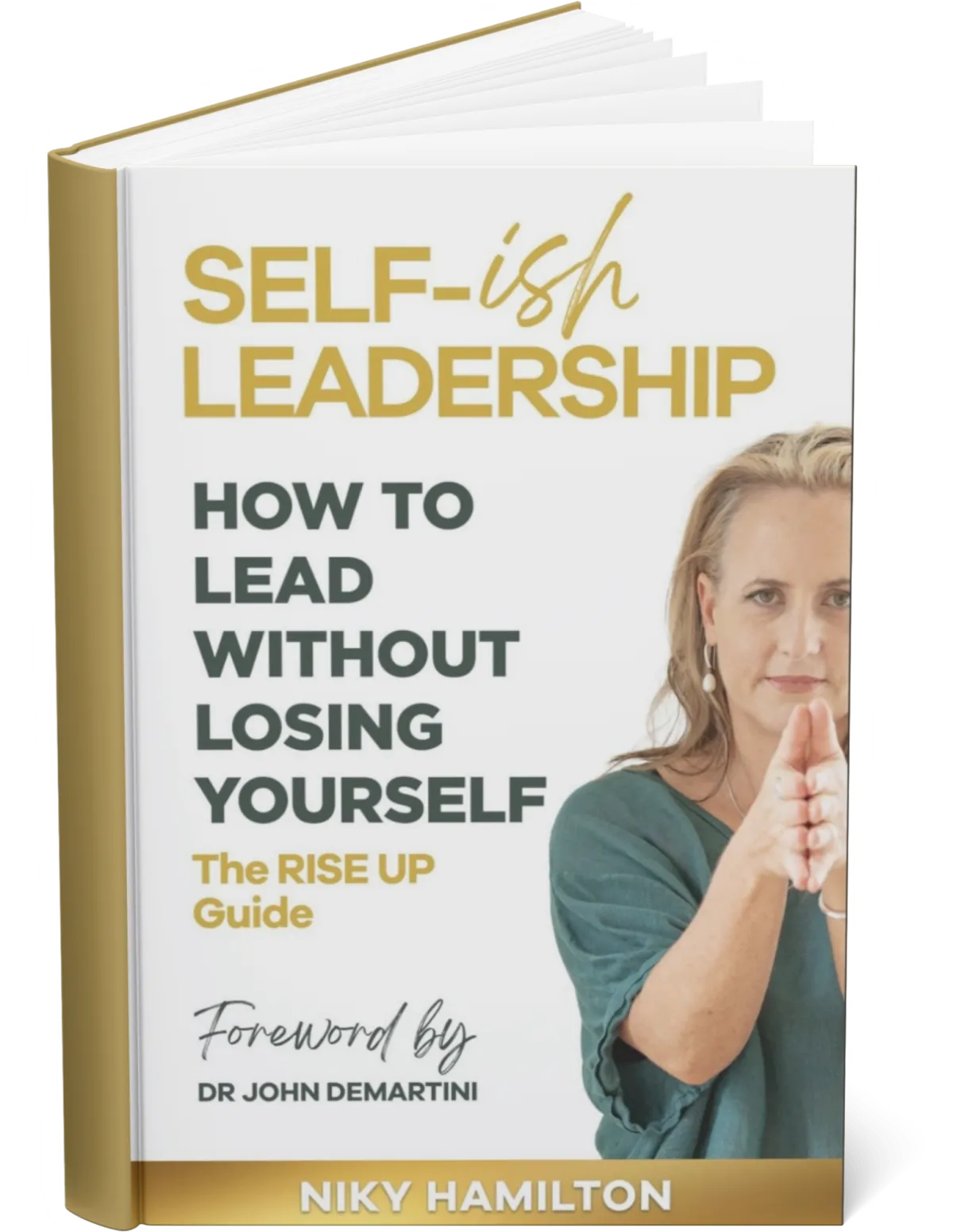
Niky offer’s her Rise UP program for women online as well as her Lead Her UP retreats for women.
Find out more about her retreats here
Listen in to Niky’s Synergy Women podcast here